Showing posts with label teaching. Show all posts

Thursday, July 21, 2011

QR Codes in Books


qrcodeI've heard tell that necessity is the mother of invention. What I like about summer is that it gives me time to think about what worked, what didn't work, and what drove me absolutely crazy in my classroom the previous year.

What you have to know about my classroom is that it's structured by Read 180. Three stations, 20 minutes a station. I tend to run into a problem when a student finishes his book and wants something else to read. While I'm teaching the small group, he'll come, interrupt the flow, and ask what he should read next.  I understand that most of the students I get are reluctant readers, I want them to learn to be independent reluctant readers. If twenty minutes is all I have with a group, I want to be able to use all 20 of those minutes and not take a quarter of them book talking to another student (not that I mind book talking--the timing is just inconvenient).

That prompted me to start making YouTube videos of my book talks. With any luck, I can get my channel unblocked at school and have a computer station set up so to the viewing of these videos can be done independently. If that doesn't work, I had another idea, which became my project for the summer.

Last school year I saw many conversations on Twitter about QR codes and using QR codes for comments. It wasn't until this summer and reading this blog post that I really understood what QR codes were and figured out how I could use them. To address my problem of being interrupted while teaching by a student who wanted a new book -- a problem I don't mind having because it means they're reading -- I decided to create QR codes that link to various YouTube videos and commentaries about books. These barcodes will be taped to the inside of the books at the beginning or end, and students can use my phone to access the content.

The fact that my phone is the device necessary for this project to work has beenthe only snag. Because YouTube is blocked, and because I want my students to be able to read whatever commentary from wherever on the web, and because I won't connect my iPhone to the wireless in my classroom, it seems like the best choice. Students have used my devices before without too much incident -- iPod nano to watch videos from Skeleton Creek and Trackers or listening to audiobooks -- so I'm not too worried. There will be ground rules. But I think having the video option will help those students who have a hard time reading the back cover of a book and deciding whether or not they want to read it.

I'll let you know how it goes.

Sunday, June 5, 2011

Not Visible Enough Part II: YA Saves

When I wrote my last blog post, I was livid. In the 30-45 minutes I spent writing, Maureen Johnson had mobilized Twitter, asking her followers (and their followers) to express what young adult literature had done for them. I set up an archive for the tweets, which you can find here. When I got up at 4 this morning, there were almost 10,000 tweets (thought the most recent tweets seem to carry the hashtag only because it's trending). According to MJ, it took 20 minutes for #YASaves to become the third highest trend in the United States.

I teach 8th grade reading. Every day, young people enter my classroom and as they do, I am asking them to trust me. I ask them to trust that I won't have them do anything without a reason, that anything I ask them to do I either plan on doing myself or have done myself. I ask them to trust me enough to tell me the truth when I ask them what they like in order to make appropriate book recommendations, and then I ask them to trust that coming to me and saying, "This isn't working for me, can we find something else," is an appropriate response to a novel.

Trust.

I'll admit that I've taught young people who were not trustworthy. At the same time I have to admit that I know adults that are not trustworthy. By not trusting young people with their book selections it's almost like saying that their thoughts, ideas, opinions and life experiences are invalid. By saying that young people should not read "dark" fiction is like saying "your experience is abnormal and no one should have to read about it."

I read through the archive and come back to this: YA authors, you are rock stars. Young people, you, too, are rock stars. It is an honor and a privilege to get to work with such amazing young people and connect with them through books written by amazing authors.

There is more that I want to say about this, but I think I'll give it a rest for now.

Thank you for being awesome.

Saturday, June 4, 2011

Not Visible Enough

Before you continue, you should check out this article from The Wall Street Journal.

I was taught that books can serve as a mirror or as a window for a reader. I've learned since that the world is decidely more complicated that just mirrors and windows, but the basic idea still holds true.

Forgive me for stating the obvious, but at it's heart, this is an article calling for mass censorship of the young adult genre of books. As a reading teacher for adolescents and as a (soon to be) university faculty member teaching teachers about literature for adolescents, I respect the right of Amy Freeman to dictate what she wants her child to read. However, to suggest that all adolescents shouldn't read these "dark" books, is going too far.

I remember in one of my first graduate courses talking about children and brain development. The discussion centered around small children and their reading habits. While I'll admit that I don't know much about early literacy because it's not my focus, one part of that conversation stayed with me. Children like to hear the same stories over and over again because they're working though something in their minds. I've seen a similar phenomenon with the six-year-old son of one of my friends, who repeatedly watched Fox & the Hound, then repeatedly watched Balto until he worked through whatever issue he was dealing with.

I've had students, eighth graders, do the same thing. An outsider might argue that they're trying to get out of reading, but I know my students well enough to know that they're processing through. Specific example? I purchased the book Truancy for a student at his request. Two days later he came back to me and said that he'd read it twice. Maybe he was dealing with issues of authority as presented in the institution of schooling, maybe he was dealing with something else. The point is this: the kid was reading, the kid chose what he wanted to read, and the kid needed to reread in order to puzzle through whatever he was dealing with at the time.

So what you're saying, then, Wall Street Journal, is that kids should struggle through their issues on their own? Let me make sure I'm understanding you correctly. Think back for me. Remember what it was like to be a teenager. How many adults did you trust with your deepest, darkest issues? But what if the right book was put into your hands at the just the right time? And what if reading that book allowed you to feel like you were a little less alone in the world. That you weren't the only one going through whatever it is you were going through. I did see you used concession/refutation to argue this point, however, there's a voice missing from your argument. An incredibly important voice, I might add.

We tend to look at our past through rose colored glasses, thinking "When I was young, things were different."

And it's true. When we were young, things were different. When I was young, I went through the whole of high school and can't remember reading anything with an African-American depicted as anything but a slave. And until I took a class specifically on African-American literature as an undergraduate English Literature major, I didn't read anything about anyone who looked like me. I read nothing about characters whose lives looked like mine outside of the race issue. I feel like I'm making up for that now.

For me, authors are rock stars. I posted on my Tumblr blog about how excited I got when Libba Bray replied to one of my tweets. I've posted in the past about conversations I've had with other authors - Laurie Halse Anderson, Ellen Hopkins, John Green, Alan Sitomer, Lauren Myracle - and how I've passed messages back and forth between these authors and my students. These students who are grateful  for the words the words that these amazing authors write. Words that speak to kids who profess to have never, in their adolescent lives, finished an entire book. Words that tell these kids that they're not alone. That the world is bigger than the small town we live in. That the intolerance they spout as truth may not actually be truth. And I, and my students, appreciate their honesty, even when it makes us angry.

A colleague of mine in the doctoral program, who used to teach high school English, tells a story about the students with whom she worked. She says as a collective they were turned off from reading because none of the character in the stories they read were of Mexican descent, lived in a poor community, or sounded the same way they did. They resented being taught by the institution that the middle-class, Midwestern, Anglo dialect was the only correct way of fitting into society. Then they read a text with a protagonist who looked like them and spoke like them and they found that reading isn't all bad.

I grew up in Indianapolis, but I live in a small town now. There are many things that many of the students with whom I work don't know about. Columbine. Surprisingly, 9/11 (I showed a video and they asked me if what they were seeing was real). Matthew Shepard. Remember him? While the reality of gang violence is something everyone knows about and deals with here, the reality of the repercussions of homophobic and even anti-Jewish slurs is not. Do we not, as educators and as authors, have a duty to broaden the minds of our students? Or is the most important goal we have to accomplish tied to a white-washed assessment?

I stand with Libba Bray, who said, "Books are, at their heart, dangerous. Because they challenge us: our prejudices, our blind spots. They open us to new ideas, new ways of seeing. They make us hurt in all the right ways. They can push down the barricades of 'them' & widen the circle of 'us'. And when one feels alone--say, because of a terrible burden of a secret, something that creates pain and isolation, books can heal, connect. That's what good books do. That's what hard books do. And we need them in the world." You can read all of her comments here.

I stand with Lauren Myracle. With Laurie Halse Anderson. With Sherman Alexie. With John Green. With Jay Asher. With Neil Gaiman. With Ellen Hopkins. With Maureen Johnson. With Meg Cabot. With all the authors who tell it, and tell it honestly. Because life can be dark. And life can be messy. And if you don't want your own kid to read about the dark mess that life can be, that's your prerogative. I respect that as an educator.

But come to my classroom. Hear the beautiful arguments that the reading of this dark literature ignites. Tell me that the end of Jacqueline Woodson's If You Come Softly isn't a reality for some kid somewhere, that it couldn't be a reality for my own brothers if they're in the wrong part of town, and tell me where else my students would learn about this reality. Tell me that these kids aren't learning, that they aren't taking something away from the novels they read as more than a guide for destructive behaviors.

Come see the community we create, then tell me we're wrong.

Saturday, September 11, 2010

Backchanneling and Socratic Seminar

I've written two posts (here and here) before on using Edmodo as a backchannel for student conversation during lessons. I discovered TodaysMeet in my twitter feed today and I've started thinking about backchanneling again.  Right now I'm locked into the READ180 progam, so I'm trying to figure out how I can incorporate these idea into that model. I definitely plan on using the ideas here when we do The Lightning Thief as a full-class read toward the end of the semester.


On Levels of Questioning
I think a big part of active engagement with a text is the ability to write the same types of questions the instructor of a class would ask about a given text. To really get students into a Socratic seminar, have them generate their own questions that will be used. There's something to be said for ownership when it comes to what students do and don't remember. Here is a link to the post I wrote this summer about levels of questioning.


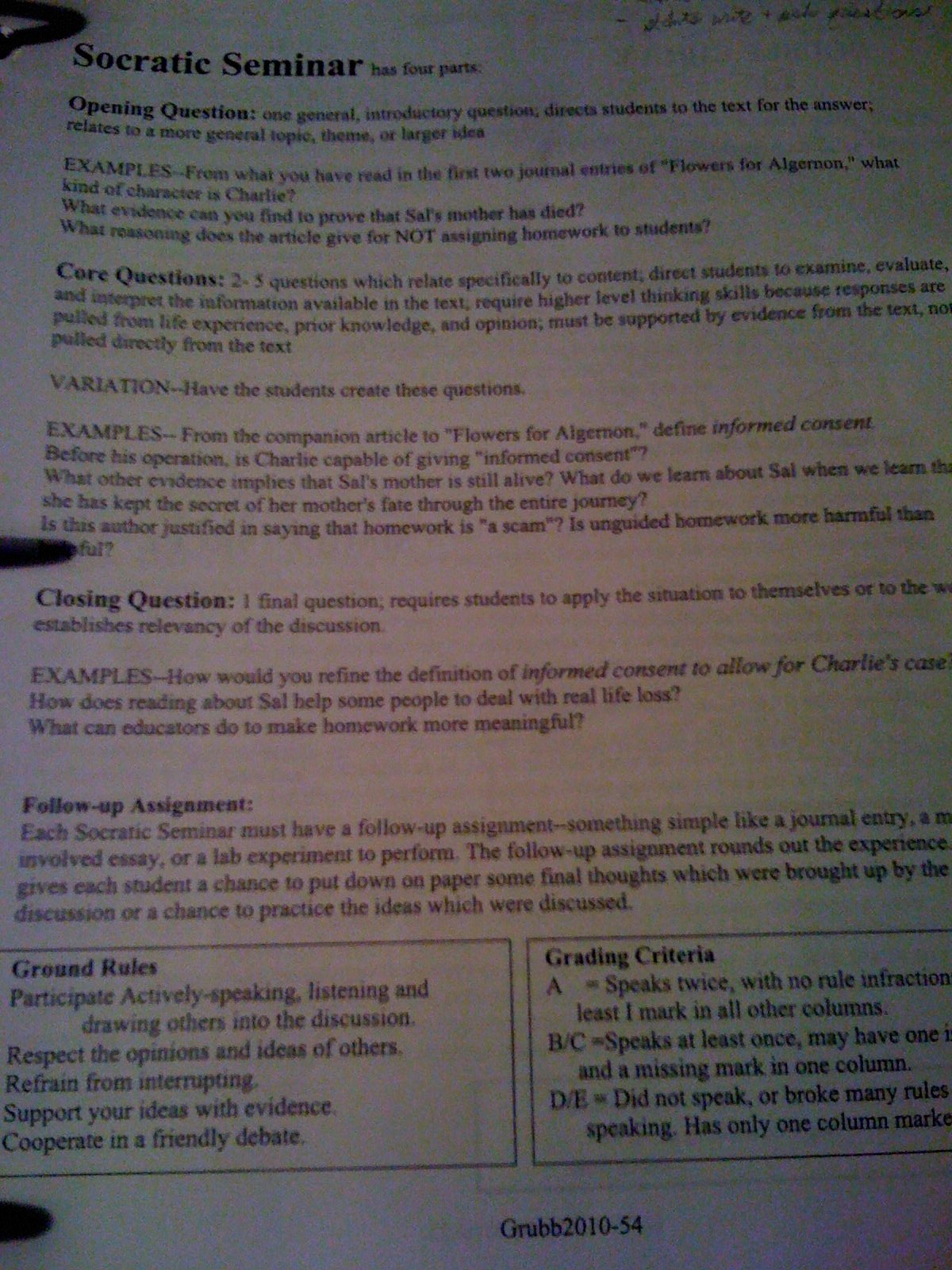
On the Socratic Seminar:
These are the guidelines we received at the Advanced Placement Summer Institute I attended this summer. They are pages 54-55 in Ayn's handbook (pdf).


Backchanneling and Socratic Seminar
There are a few things I know about myself as a student. First, when I'm taking notes by hand, I am less engaged whatever discussion is going on around me because I'm so caught up in getting all of my notes on the page. I also know that if I'm not engaged somehow, whether it be note-taking by hand, on twitter, or live blogging, I am more likely to let my mind wander during class. Do I honestly expect anything different from my students? Hardly.


In theory, the students in the outer circle (if you're taking the fishbowl approach to Socratic Seminar) are paying attention to the conversation occurring in the inner circle. They might be paying a little more attention if they wrote the questions the inner circle is answering, but as a student, that still wouldn't actively engage me. I propose a way* to further involve outer circle students in the seminar. (Note: I realize this will be a more of a distraction for some students than others.)
Have the outer circle students take live, electronic notes via backchannel about the inner circle's conversation. They can make note of interesting things people say, aspects of/places in the text that they referenced to answer particular questions, and offer brief commentary on their peers' conversation. When I was reading about Google Wave and its uses in education, people discussed using Wave for collective note taking. Using Edmodo, Twiducate, or TodaysMeet for backchanneling does the same thing. This frees up the inner circle to concentrate more on their conversation and less on taking any notes they would otherwise take. With collective note taking, the outer circle students are more likely to commit more of the conversation's ideas into notes. It also allows students to pay enough attention to the conversation that they can redirect the inner circle by asking different questions as the opportunities arise (assuming the discussion questions are mostly provided by the students). Copy conversation and post to blog or wiki to refer to later.
*Originally I had two different (albeit similar) ways to approach this, but as I was typing decided that this was the better of the two.

Comments? Suggestions? Bugs you see in the system? All thoughts are welcome. :-)

Sunday, September 5, 2010

How I'm Rethinking Homework

I was waiting for this column to go live on Language Arts New Mexico, but last I checked it hasn't made it there yet. I've copy/pasted it here for your reading pleasure. Every year I take on a new action research project; something designed to make my teaching and my students' learning easier and more relevant. This past summer, I read a collection of essays by Alfie Kohn entitled What Does it Mean to be Well Educated? I thought about other articles I've read by Kohn, in particular, "Rethinking Homework" (2007) which can be found here. I've heard the arguments for and against homework. This is my response.

NewImage.jpg

Kohn, A. (2007). Rethinking homework. Retrieved from: http://www.alfiekohn.org/teaching/rethinkinghomework.htm

Sunday, August 22, 2010

Rough Start

Last week was the first week of school, and the first time we've ever started on a Monday. In previous years, we started on Wednesday or Thursday--two or three days to get to know the students, then the weekend and Deming Duck Races, then we'd hit the ground running the next Monday. Everyone felt like the week was a little long. It didn't help that all the housekeeping type items that had to be completed were completed during first period.

Despite ongoing internet problems, it is very exciting that so many of my students are excited about the books they're reading. Almost all of them have selected books out of my personal library. I admit that there are some books I was more excited about students reading than others -- I think there are four students reading Patrick Carman's Skeleton Creek, and three reading his novel Trackers, drawn in by the fact that there are videos. Others are reading Shusterman, Anderson (both MT and Laurie Halse) and a myriad of other books on a myriad of topics. The neatest thing is to see one student lean over to another during independent reading and point to something in the book they're reading, then look to see if they'll get in trouble for talking. I encourage this kind of interaction. I want my students to talk about books, not just with me, but with their peers as well. And it has already begun.

I do hope that the server problems, particularly in the afternoon, are resolved. Because I teach the Title I Language Arts class, there are some requirements must make sure my students meet, like using the Scholastic READ180 program so the powers that be have the ability to pull student reports to monitor progress. I also hope that this week passes with less frustration than last week did.

Sunday, August 15, 2010

A New Look at Percy Jackson

The Lightning Thief (Percy Jackson and the Olympians, #1)The Lightning Thief by Rick Riordan

My rating: 4 of 5 stars


It's so different reading this book through the lens of a teacher. This time, I read the teacher's guide as I was reading the novel. That process made me focus not only on the progression of the story and the hero journey (because I love the hero journey archetype), but also on the specific Greek myths in each chapter, and the foreshadowing, which is a whole lot easier to spot when the reader has a good idea where the story is going. I was also more aware of characterization given the criticism of the movie, where Percy is portrayed as well into his teens rather than as a 12 year old.I anticipate using clips from the film to illustrate points or to initiate debate over which author made the better choice, but I definitely won't be showing the entire thing.

View all my reviews >>

Tuesday, June 15, 2010

Freytag Revisited

When I was in school, plot diagrams (which I learned later were called Freytag's pyramids) looked something like this:
Image from Wikimedia.org at http://goo.gl/W0fN


There is argument that plot doesn't rise smoothly from the exposition to the climax, instead containing a number of smaller climaxes where an element of the conflict is settled--that is to say that the reader knows which way something will go for the character. 

I took a methods course on teaching Language Arts a few semesters ago, and my professors suggested a different take on the plot diagram. I didn't think too much of it, until last week when the facilitator for the NM APSI workshop made the same suggestion, then showed us how it worked. Freytag's Pyramid revised looks something like this: 


Example: A man dressed in black is running up to a roof with a black briefcase tucked under his arm. As he runs, he glances over his shoulder. When he reaches the far side of the roof, he crouches, opens the briefcase and presses a button. An orange timer appears showing 3:00. The timer begins to count down. 2:59... 2:58... The man looks over his shoulder one more time and runs off toward the fire escape on the other side of the roof.
2:55...
2:54...
He doesn't make it to the fire escape when another man runs onto the roof and catches him. They fight. The first man pulls out a knife. 
2:30...
2:29...
The good guy kicks the knife away and they exchange more blows. The good guy is knocked off his feet. But before the bad guy can get away, the good guy sweeps his legs.
1:45...
1:44...
The bad guy kicks the good guy in the face and the good guy blacks out, giving the bad guy the opportunity to get away. 
0:30...
0:29...
The good guy wakes up and sees the clock ticking at 30 seconds. He rushes toward the briefcase and looks around, realizing the bad guy got away. Then he pulls a pair of wire clippers out of his pocket and examines the wires.
0:10...
0:09...
Finally he snips the green wire and breathes a sigh of relief.
0:03.
Was there a climax in that story? What if I said that this scene occurred in the middle of a larger story where the rising action to the final climax was a car chase/huge battle scene?


Because our workshop had an emphasis on vertical teaming, we discussed introducing a simple plot diagram like the one pictured first, when we introduce plot in the sixth grade, then working with the students, building and extending on their prior knowledge and introducing the second plot diagram later on.


Ayn Grubb, our presenter, has a neat lesson using the first 15 minutes of Indiana Jones, Raiders of the Lost Ark to talk about suspense, climaxes, characterization, and other elements of plot. It can be found on pages 26-33 of this handout (link to a PDF).

Saturday, June 5, 2010

Why I Love Google Voice or...

..When things Work Exactly the Way I Want them To.

Over the last winter break, I requested access to Google Voice. I was accepted and set up the best number I could think of where the last four numbers spell BOOK. Perfect for a reading teacher, right? My thinking when setting up the number was:
Now my students can contact me outside of school if they need to, they're not using my home or cell number, and Google keeps a record of everything.

During the school year, some of the readers I roped into reading early on would text me in the evening if they finished their book and ask me to bring another to school for them the next day. I'm sure they thought I was weird, but this made me ecstatic.

Yesterday, I had the following conversation with a student (edit: when I was having the conversation, I wasn't sure who the student was. Looking back at my Google Voice records, now I know.)


StudentHey ms o have any new good reading recommendations? 2:06 PM
MeKeeper by Mal Peet. I just read it and it was awesome. About soccer and the world cup winning goalkeeper. What are you looking for? 2:07 PM
StudentJust any new books lol im going to be taking a trip up to barnes and noble and im hoping to find a couple of good ones  2:08 PM
MeThe Absolutely True Diary of a Part Time Indian by Sherman Alexie. You wanna give me a few topics so I can narrow my recommendations? 2:10 PM
Studentmystery and maybe a comedy ?  2:11 PM
MeI'm on my way home right now, I'll take a look and text you in a few. 2:12 PM
StudentOka thank you :)  2:13 PM
MeFor humor: No More Dead Dogs by G. Korman, The Schwa Was Here by N. Shusterman, Fancy White Trash by M. Geerling 2:28 PM
MeFor mystery: The Compound by S.A. Bodeen, I, Q Independence Hall by R. Smith, The Tomorrow Code by B. Falkner, The Adoration of Jenna Fox by M. Pearson. 2:31 PM
MeHope that helps. Text me when you're there if you still need help. 2:31 PM
StudentOka thank you :) :)  2:31 PM

What happened here was the thing I dreamed would happen, but didn't figure would. A student needed something to read, remembered that I give suggestions, and even though she's no longer in my class, used her resources to get where she was trying to go. And that conversation with her totally made my day.

Thursday, April 22, 2010

Facebook Snags

I did a dry run of the facebook project that I've talked about here and here and that David talks about here, on Monday in my college class. What I learned from the dry run is that editing templates in Google Docs isn't super user-friendly. Needless to say, I was disappointed and needed to go back to the drawing board. So I thought to myself, "Okay. I can post a PowerPoint version of the template, and groups and download/upload their files to Google Docs and we still don't have the 'X has the USB and she's not here today,' problem."

Tried that today and come to find out that files cannot be uploaded to Google Docs through the laptop computers we were using, and they'll only send through Gmail if we're using the older version. So what I've resigned myself to doing is creating a conversation between the class email I set up and myself. They'll download their most recent file from the conversation and email it to me when they're done at the end of the class period.

In the end, teachable moment was about problem solving. An added bonus: most of my students don't have email addresses, so they'll learn how to attach a file before the get to the high school.


Why Getting to Know Your Students Is Important

Once, this semester, my principal told me that I have a student who will work for me and not for anyone else. What's interesting is that I had a few confrontations with this student at the beginning of the semester, that boiled down to me telling him that while I will treat him with respect because I have a job to do, he still has to earn my respect and the privilege to change seats (which was the question at hand). I bring this up because one of his other teachers came into my classroom this morning talking about the student, who happened to be in the room at the time. She went on about how he wouldn't do anything for her and had bad grades across the board, and she's recommending him for summer school. That's all fine and dandy, I like the kid. I'm sure he's not going to be thrilled that he gets to spend another summer with me, but at least I got him to work for me.

How did I do this, you might ask? 

Easy. I listened to what he said to me and found a book that matched his interests and then listened to him when he talked about the book. Therefore, he'll make an effort to learn what I'm trying to teach him. 

I thought about this because I got another student I was trying to reach. He's a self-professed player, who's smooth talking, but really didn't like to do what he was asked. I gave him Homeboyz by Alan Lawrence Sitomer, and he liked it, but lost it. Then I gave him Mexican WhiteBoy by Matt de la Pena which he skimmed through without reading too much in depth. For book groups, he's reading That Was Then, This Is Now by S. E. Hinton. When he came in today I told him that my favorite line from the book was "If you have two friends in your lifetime, you're lucky. If you have one good friend, you're more than lucky" (49). Before I could finish reading the quote, though, he'd finished it for me. 

Later, he tells me that he's never read a book all the way through. He liked The Outsiders, but never finished it either. Right now he's feeling pretty proud of himself. And I'm feeling pretty proud of him.

Hinton, S.E. (1971). That Was Then, This Is Now. New York: Speak.

Wednesday, March 17, 2010

French Award Proposal

In the laundry list of things I had to have done by Tuesday, one of the most interesting was my proposal for the French Award. The French Award gives $5000 to a teacher to fund a project they're interested in incorporating into their class.

My project involves using video as a synthesis of student learning. The items I'd purchase to create my project are a Flip Video Camera, an Elmo Document Camera, 6 iPod Touches, a 1 TB external hard drive and somewhere in the neighborhood of 90 FollettBound novels (they're a little more expensive, but Follett will replace any damaged book for free, and kids can be pretty hard on books).

Here's a basic outline of the project--know that I'm pretty excited about this, and will probably try to do it even if I don't get it funded.


1.     Students will vote for one of six thematic: Natural Disasters, Self-Identity, Truth, Acceptance, Survival, and “Big” Issues. Based on their responses, a thematic unit and other related texts (readings, videos, music and art) will be chosen.
2.     Through mini-lesson, teacher created podcasts to be viewed in small groups on iPods, teacher guided practice, small group practice, reciprocal teaching and independent practice, students will learn about varied sentence structure, vocabulary, reading strategies and other elements of language arts as they are presented in their language arts classes. All of this knowledge will be incorporated into the script for the film they will produce at the end of the six weeks.
3.     Each week, students will compose a blog post (web host to be determined), reflecting on their learning, reflecting on their thoughts about the theme in terms of their personal experiences and their reading, and suggesting ways that their learning and connections can be incorporated into one of the six film categories (these categories will be used as tags for easy reference later, other categories will be added based on the theme selected):
a.     Anticipation—what we thought before we started reading
b.     What we read—short summaries of the novel text and other texts read, viewed or heard during the unit, what was learned from them, how they connect together and to the theme
c.     Visual Art—representation of the theme in an artistic way, either researched or student created
d.    Music—type, style, genre, specific examples that might fit the theme
e.     Film—People who think this theme is interesting might also want to see what movies? (Find trailers on YouTube)
f.      Where we ended up—our final thoughts and how our initial thoughts changed or stayed the same
4.     In the fourth week of the unit, students will be divided into specific production teams of no more than three students based on the categories listed above. Students will begin using their weekly blog reflections and the blog reflections of their peers to create a script for a 2-4 minute presentation on their category. During this time we will still continue to have reading and writing strategy, and vocabulary lessons.
5.     Each day in the fifth week of the unit, a group will present their script to the class using the document camera. They will solicit feedback from their peers on revision making notes on their copy as they go about what they should include that hasn’t been included, what can be removed, how to incorporate their vocabulary and writing/grammar into their script. The group will then take those suggestions and revise their script accordingly. They will spend time practicing their script, reading with fluency and expression.
6.     In the first three days of the last week in the six weeks, groups will record/create their portion of the presentation. Students can use video cameras, PowerPoint presentations saved as movies, Windows Movie Maker, scanners or any other necessary technology to create. All video or files will be saved on the external hard drive. Students who have had the technology class as an elective or who are interested in learning how to put together a film will come to my class during lunch to put together the pieces of the film.
7.     The second to last day of the unit will be a viewing of the films from each class. Students will be able to see how their peers in different classes synthesized their learning.
8.     The final day of the unit, students will write a blog post reflecting on what they learned about their theme, their thoughts on the film aspect of the project, what worked well for them and what didn’t, what else they’d like to learn and how we could work better as a community of readers and learners. We will use our blog posts as a springboard into class discussion and debriefing.
9.     At the end of the semester, all parents will be invited in for a Literacy Night were we will show the films students created to their parents and discuss student accomplishments fort he semester.

Monday, February 15, 2010

Creative Thinking Questions

I'm always looking for new ways to assess my students' reading without making them do a book report. I honestly have never assigned a book report and I don't think I ever will. But there still has to be some accountability for their reading. How else would I know whether or not they do what I ask?

In thinking about this last week, I stumbled across the memory of attending the New Mexico AP Summer Institute in Albuquerque in June 2006. The presenter for the workshop I attended included a "Creative Thinking Test" for a specific novel in with our materials. My favorite question was #4, the Creative Thinking Questions. These questions asked readers to think figuratively about their novel, comparing a character or an event to an object, color, or personal characteristic. I have taken this idea and expanded it to a longer (and not finished) list of comparisons.

My students have answered some of these questions before, but many of them didn't come up with the result I was looking for. So I'm going to take a more structured approach.

Concepts Addressed
  • Test prep - how to respond to short answer questions.
  • Marzano: Similarities and Differences (and SIOP: use of graphic organizer)
  • Figurative language
  • Reading Comprehension
  • Revision
The plan is to model the activity step-by-step. So I'll model, they'll do. I'll model, they'll do. The goal is that they'll come to understand that some questions have more than one part that needs to be answered. I reformatted this list so each question will fit on an index card. The beauty of doing that is I can do this activity more than once, and students are not likely to draw the same question twice.

In looking at steps 1 and 2, I did organize it this way on purpose. Often, students will do a cold answer of a question without really thinking about it. I want them to be able to compare that type of answer to an answer that is well thought out, and the only way to do this is by not having them plan their answers first.
    The Activity
    Step 1: Each student draws a card, reads it, writes it down on his/her paper, then answers it.
    Step 2: Using a T-Chart, write down the characteristics of the character or event chosen, and the figurative term (underlined) on the card.
    Step 3: Look at how the question is broken down. Using colored highlighters or 3 different colored pencils, mark the three parts to the question.
    Step 4: Review answer written. Mark answer with corresponding colors.
    Step 5: One color at a time, expand the answer so that it completely answers each part of the question. Check those sentences for grammar and spelling mistakes.
    Step 6: Rewrite paragraph in a cohesive way, remembering to indent, etc.

    The Questions
    Creative Thinking Questions

    Sunday, December 13, 2009

    I Must Be Doing Something Right

    The last grading period this semester my students participated in book groups. They used Edmodo to converse with students in other classes and completed imaginative response projects as a way to respond to their reading. In my morning classes, many of the students finished their novels well before the end of the grading period. Because they're writing me book notes, and it is a reading class after all, they were/are still required to read during full-class SSR.

    Of the 15 students in my first period class, 8 are reading books I've either started during a read-aloud, or books that they've seen me read over the course of the semester. Two of those eight students asked me specifically for a book they saw me read that they found interesting. One of the kids saw one of my reader response projects and asked me to explain. I told him to read the book to figure out what it meant, and he did.

    All of this is to say there is power in reading aloud to middle school students. There is power in doing book talks with reluctant readers. There is power in completing and displaying the projects you ask students to complete. There is power in modeling silent reading and entertaining the questions they ask about your book. They're NOT always stalling. And teachers shouldn't listen to instructional leaders who say that middle school students shouldn't be read to.

    Some of the books I've read this semester that students picked up:

    Sunday, November 22, 2009

    A Character Alphabet (Part 2)

    Here's G through M

    G is for the gate that Margo and Q had to scale on their adventure when they broke into Sea World, the last amusement park in Orlando that Margo had to break into.

    H is for the high that Q feels when he figured out that paper towns were not abandoned housing developments, but instead a mapmaker’s way of catching copyright infringement. Then he finds out that Margo was in Algoe, a paper town with one building.

    I is for the intensity with which Q loves Margo, even though they hadn’t been friends since they found Robert Joyner dead in Jefferson Park.

    J is for Jefferson Park, the location where Margo and Q found Robert Joyner when they were nine.

    K is for the killing of the Joyner, a detail that Margo changed for the story she wrote about her and Q when she was 10.

    L is for leaving, which is what Margo did. She told Q that leaving was something she had to do for her. She couldn’t live near her parents or the city of Orlando anymore.

    M is for Margo Roth Spiegelman, the girl that everyone thought they knew, who sees herself as a paper girl, in two dimensions.

    Monday, July 20, 2009

    On Read-Alouds

    I'm not sure I have a blog roll on my blog anymore, especially since the blogs I follow all run through my Google Reader, but I read this post on The Reading Zone, and had to share.

    One of the strategies I started using this year to get my students interested in stories is the read-aloud. I had a novel that I read aloud to the class when we'd have extra time at the end of the period. The only one we got to this year was Dreadlocks by Neal Shusterman, but I already have a list lined up for the fall, including Sherman Alexie's The Absolutely True Diary of a Part-Time Indian, Sharon G. Flake's The Skin I'm In, and Richard Wright's Rite of Passage. I might pull in some more Shusterman, but I haven't decided yet. Hopefully, the book talks I'm planning to put into my weekly podcast will help me and the students decide what I should read to them--what will get them interested in reading the most.

    My favorite book off of her list has to be The Giver by Lois Lowry. I recently finished the third in the series, called Messenger. Fantastic. I should have blogged about it, but I think it's one of the novels I read recently that has yet to make it up here.

    One aspect of TheReadingZone's post that I particularly liked was her students' comments on their novels. She mentions that she has students read a variety of genres, authors, etc. so at least something resonates with each of her students. What I like even more was that she has them register an opinion. I want to take a page out of her book.

    The List of novels (and only the novels) I'm considering for my 8th graders (they'll get to choose)
    I think there might be more on that list, but I can't remember off the top of my head.