Showing posts with label AP-NM. Show all posts

Saturday, September 11, 2010

Backchanneling and Socratic Seminar

I've written two posts (here and here) before on using Edmodo as a backchannel for student conversation during lessons. I discovered TodaysMeet in my twitter feed today and I've started thinking about backchanneling again.  Right now I'm locked into the READ180 progam, so I'm trying to figure out how I can incorporate these idea into that model. I definitely plan on using the ideas here when we do The Lightning Thief as a full-class read toward the end of the semester.


On Levels of Questioning
I think a big part of active engagement with a text is the ability to write the same types of questions the instructor of a class would ask about a given text. To really get students into a Socratic seminar, have them generate their own questions that will be used. There's something to be said for ownership when it comes to what students do and don't remember. Here is a link to the post I wrote this summer about levels of questioning.


On the Socratic Seminar:
These are the guidelines we received at the Advanced Placement Summer Institute I attended this summer. They are pages 54-55 in Ayn's handbook (pdf).
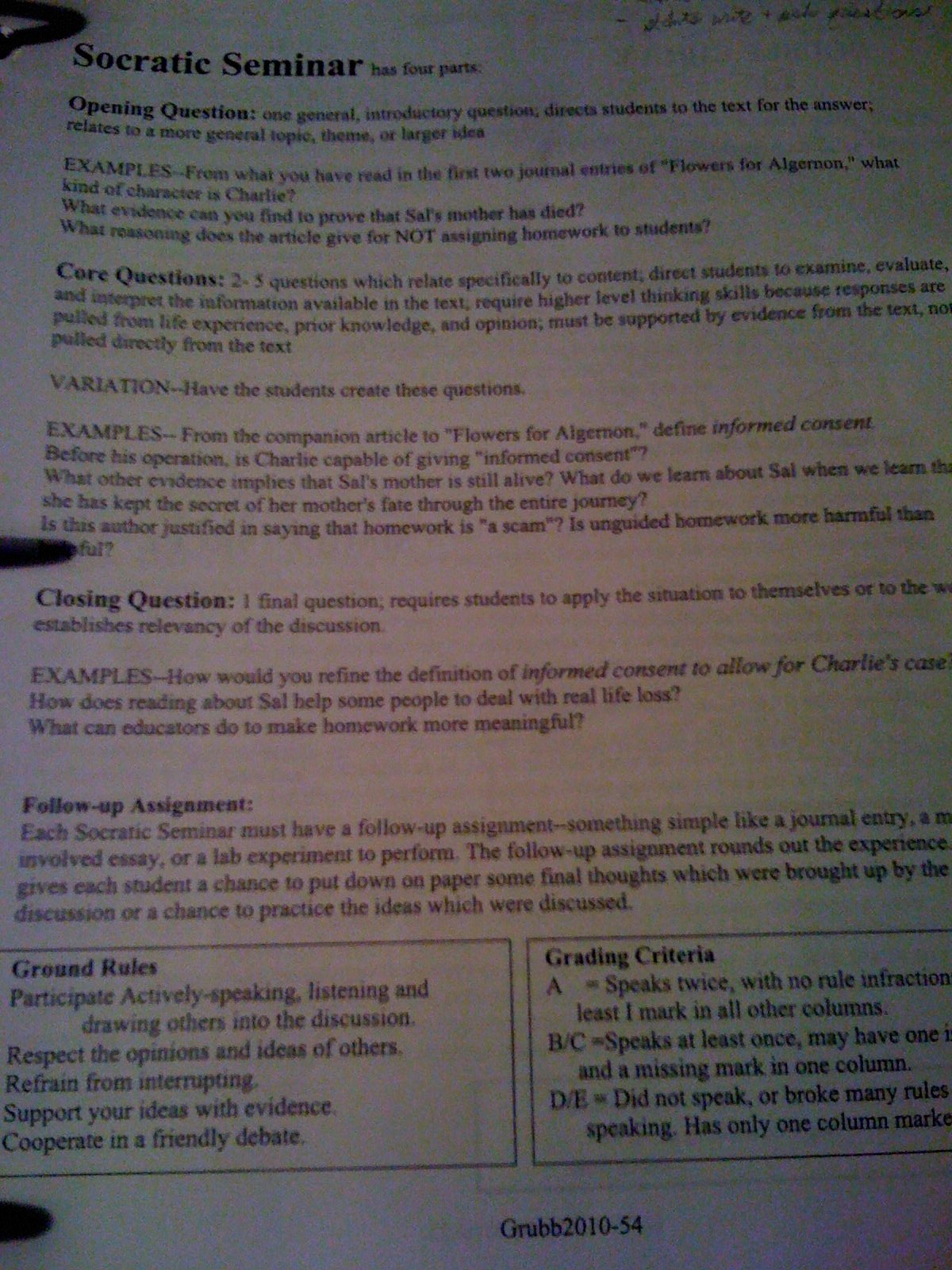
 

Backchanneling and Socratic Seminar
There are a few things I know about myself as a student. First, when I'm taking notes by hand, I am less engaged whatever discussion is going on around me because I'm so caught up in getting all of my notes on the page. I also know that if I'm not engaged somehow, whether it be note-taking by hand, on twitter, or live blogging, I am more likely to let my mind wander during class. Do I honestly expect anything different from my students? Hardly.


In theory, the students in the outer circle (if you're taking the fishbowl approach to Socratic Seminar) are paying attention to the conversation occurring in the inner circle. They might be paying a little more attention if they wrote the questions the inner circle is answering, but as a student, that still wouldn't actively engage me. I propose a way* to further involve outer circle students in the seminar. (Note: I realize this will be a more of a distraction for some students than others.)
Have the outer circle students take live, electronic notes via backchannel about the inner circle's conversation. They can make note of interesting things people say, aspects of/places in the text that they referenced to answer particular questions, and offer brief commentary on their peers' conversation. When I was reading about Google Wave and its uses in education, people discussed using Wave for collective note taking. Using Edmodo, Twiducate, or TodaysMeet for backchanneling does the same thing. This frees up the inner circle to concentrate more on their conversation and less on taking any notes they would otherwise take. With collective note taking, the outer circle students are more likely to commit more of the conversation's ideas into notes. It also allows students to pay enough attention to the conversation that they can redirect the inner circle by asking different questions as the opportunities arise (assuming the discussion questions are mostly provided by the students). Copy conversation and post to blog or wiki to refer to later.
*Originally I had two different (albeit similar) ways to approach this, but as I was typing decided that this was the better of the two.

Comments? Suggestions? Bugs you see in the system? All thoughts are welcome. :-)

Saturday, June 19, 2010

What I Learned about Allusions

Ayn Grubb started us off with a picture. Looks like this:
from NM APSI 2010 handout p. 169
A complaint I've heard (and I admit, have given my students as a reason to study Greek mythology) is that students don't read, therefore lacking the background knowledge necessary to understand what purpose allusions have in a story.

There are some clues we can use to help our students recognize when there is an allusion: something that doesn't fit--something that's outside the story.
from NM APSI 2010 handout p. 170

So how do we go about scaffolding the instruction? Guiding students to think about why an author would choose to make an allusion rather than spelling everything out. In session, we read an excerpt of "Raymond's Run" by Toni Cade Bambara. Then we filled in a T-Chart with information on what we know about Dodge City (which I didn't know anything about until someone said "Wild West"), and what we knew about Squeaky walking down the street in Harlem. 

from p. 172...and my notes
The difference between this exercise and the T-Charts as I've seen them used at school is the question at the bottom: "What greater meaning is added to the story by this allusion?" We looked at what Bambara implied without really using all the words, and came up with a purpose for the allusion. For me, this was T-charts in a totally different light.

Tuesday, June 15, 2010

Freytag Revisited

When I was in school, plot diagrams (which I learned later were called Freytag's pyramids) looked something like this:
Image from Wikimedia.org at http://goo.gl/W0fN


There is argument that plot doesn't rise smoothly from the exposition to the climax, instead containing a number of smaller climaxes where an element of the conflict is settled--that is to say that the reader knows which way something will go for the character. 

I took a methods course on teaching Language Arts a few semesters ago, and my professors suggested a different take on the plot diagram. I didn't think too much of it, until last week when the facilitator for the NM APSI workshop made the same suggestion, then showed us how it worked. Freytag's Pyramid revised looks something like this: 


Example: A man dressed in black is running up to a roof with a black briefcase tucked under his arm. As he runs, he glances over his shoulder. When he reaches the far side of the roof, he crouches, opens the briefcase and presses a button. An orange timer appears showing 3:00. The timer begins to count down. 2:59... 2:58... The man looks over his shoulder one more time and runs off toward the fire escape on the other side of the roof.
2:55...
2:54...
He doesn't make it to the fire escape when another man runs onto the roof and catches him. They fight. The first man pulls out a knife. 
2:30...
2:29...
The good guy kicks the knife away and they exchange more blows. The good guy is knocked off his feet. But before the bad guy can get away, the good guy sweeps his legs.
1:45...
1:44...
The bad guy kicks the good guy in the face and the good guy blacks out, giving the bad guy the opportunity to get away. 
0:30...
0:29...
The good guy wakes up and sees the clock ticking at 30 seconds. He rushes toward the briefcase and looks around, realizing the bad guy got away. Then he pulls a pair of wire clippers out of his pocket and examines the wires.
0:10...
0:09...
Finally he snips the green wire and breathes a sigh of relief.
0:03.
Was there a climax in that story? What if I said that this scene occurred in the middle of a larger story where the rising action to the final climax was a car chase/huge battle scene?


Because our workshop had an emphasis on vertical teaming, we discussed introducing a simple plot diagram like the one pictured first, when we introduce plot in the sixth grade, then working with the students, building and extending on their prior knowledge and introducing the second plot diagram later on.


Ayn Grubb, our presenter, has a neat lesson using the first 15 minutes of Indiana Jones, Raiders of the Lost Ark to talk about suspense, climaxes, characterization, and other elements of plot. It can be found on pages 26-33 of this handout (link to a PDF).

Monday, June 14, 2010

NM APSI Reading List

I think it's impossible to put a group of Language Arts teachers together and not end up creating some sort of reading list. I'm going to share here what a group mostly middle-grade English teachers came up with.

The Hunger Games by Suzanne Collins
Grade: 8; Skill: Hero Journey, character archetype

The Pearl by John Steinbeck
Grade: 8; Skill: internal/external conflict, symbolism, literary elements

Hatchet by Gary Paulsen
Grade: 6; Skill: internal conflict

Ender's Game by Orson Scott Card
Grade: 8/9; Skill: Figurative language, vocabulary, complex sentences, characterization, point of view

Touching Spirit Bear by Ben Mikelson
Grade: 6; Skill: Figurative language, internal/external conflict

Call it Courage by Armstrong Sperry
Grade: 6; Skill: Figurative language

Sleeping Freshmen Never Lie by David Lubar
Grade: 8/9; Skill: Literary elements, internal/external conflict

The Ear, The Eye and the Arm by Nancy Farmer
Grade: 7/8; Skill: The archetype of the hero's journey

Maniac Magee by Jerry Spinelli
Grade: 6; Skill: Figurative language, conflict

Stargirl by Jerry Spinelli
Grade: 7; Skill: Conflict, characterization

The Giver by Lois Lowry
Grade: 8; Skill: internal conflict, allusion

The House on Mango Street by Sandra Cisneros
Grade: 8/9; Skill: Point of view, figurative language, mood, tone

Les Miserables by Victor Hugo
Grade: 10; Skill: literary & rhetorical elements

The Oustiders by S.E. Hinton
Grade: 7/8; Skill: Internal/external conflict, theme

Esperanza Rising by Pam Munoz Ryan
Grade: 6; Skill: Internal/external conflict, figurative language

Thursday, June 10, 2010

2Q2T

This morning we talked about how to help our students write good theme statements. Our presenter called her process 2Q2T or Two Questions to Theme.

First question:
What is this (story, poem, letter, speech, play, piece, etc.) about?


Here students generate a list of topics for whatever it was they read. We read the poem "Dandelions" by Deborah Austin. Some of the topics we generated for this poem were

  • war
  • flowers
  • weeds
  • gardening
  • warfare
The answer to the first question is plugged into the second question where it says topic.

Second Question
What is AUTHOR trying to say about TOPIC?

If I choose to talk about war then my question looks like this:

What is Austin trying to say about war?

In "Dandelions," Austin is trying to say that in war situations, soldiers never give up.

From here, students answer their questions, which becomes the claim sentence for their claim-evidence-commentary paragraphs.

Below, my notes. Glean from them whatever you can.


Wednesday, June 9, 2010

Reading and Lines: Guiding Students to Question

The student who answers questions is passive. The student who writes/asks questions is active.  That being said, how do we get students to ask questions that are meaningful and thought-provoking?

Teach them how to write leveled questions.  What are leveled questions, you ask? They're questions that are on the line, between the lines and above the lines. That is...

Level One: (on the line): Questions answered with facts from the text. You can put your finger directly on the answer.
ex.  In Goldilocks and the Three Bears, which bowl of porridge did Goldilocks eat?

Level Two (between the lines): Questions that require an inference to answer. You can put your finger on the evidence that supports the answer.
ex. What kind of person is Goldilocks?


Level Three (above the lines): Questions that are open-ended and draw in our own schema as well as evidence from the text.
ex. What different kinds of reactions can people have if someone breaks into their house?

Some uses for the questions students generate:
  • Socratic seminar
  • Fishbowl discussion
  • Games
We've talked in workshop about student involvement. If we want students to engage with the texts we're asking them to read, they have to take some ownership of the material and the learning process. I'm willing to bet that they'll care more about the answer to a question they've written than an answer to a question I've written. 

It's not enough to want kids to question everything. We have to show them how.

Tuesday, June 8, 2010

Scaffolding Writing

In our district, we use the RACE rubric for writing:

R: Restate the question
A: Answer the question
C: Cite evidence
E: Explain how evidence answers the question

It's not a bad format for struggling writers, just to give them a starting place and formula to plug their information into. I don't think it's a terrible scaffolding tool, however it's so formulaic that writers that aren't struggling can't grow or develop voice. The presenter for the workshop I'm attending this week, the Advanced Placement Summer Institute offered different words for the same type of writing formula:

Intro - which includes context, an interesting statement, or foreshadowing what's to come.
Claim - the statement that the writer is trying to prove
Evidence - a pithy statement one that contains the most meaning
Commentary - from your own head -- explain how your pithy statement proves claim

We started yesterday's session with interviews. Participants then took comments from those interviews, then built a claim-evidence-commentary paragraph around whatever comment participants saw as pithy. (I didn't get to participate because I came in late.) I was listening to people read their paragraphs, and I heard the thing that was lacking from RACE paragraphs. Voice.

I write RACE paragraphs and often feel like they're lacking that tongue-in-cheek type tone that my mother hates.

We brainstormed purpose/use of claim-evidence-commentary way of responding and here's what we came up with:

  • helps pinpoint ideas
  • for literary analysis - focus on one piece of evidence
  • helps express voice
  • use for rhetorical analysis
  • if every response is framed as an argument, the idea of "claim" works
  • helps refine thinking
  • format not limited to questions
The AP teacher in the midst of participants likes this format. She says that it gets them ready to do the kind of literary analysis students will have to do when they get to the 11th and 12th grade.